
Blog
- Home
- Blog
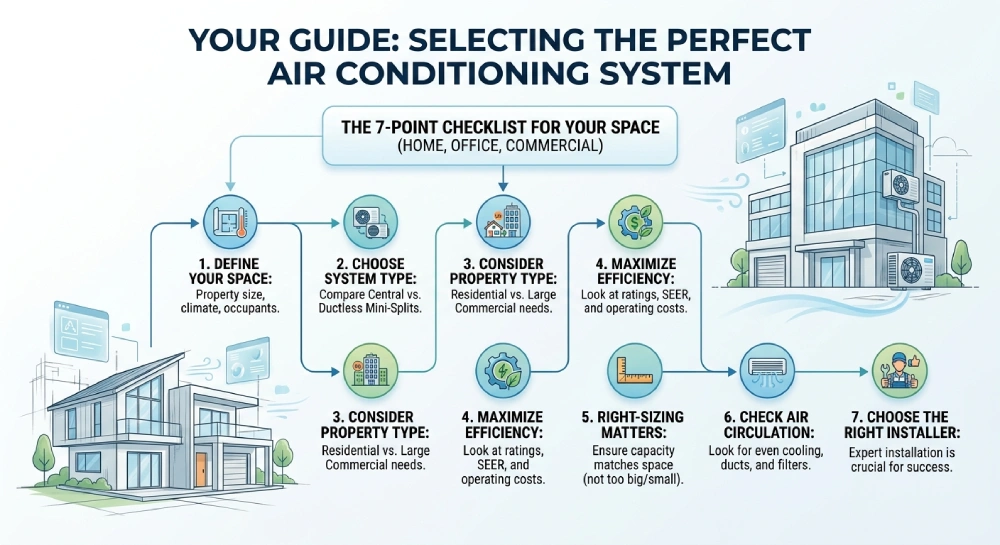
Selecting the appropriate air conditioning system can help to optimize comfort, energy consumption and operating costs over time. This is dependent on the size of the property, the cooling requirements, the layout of the property and the budget.
These seven points of the air conditioning system can be helpful to you in making a practical decision for a home, office, retail or a larger commercial building.
The first thing to think about is the size of the property and how it is designed. Proper system selection and air circulation can help distribute cooled air more evenly throughout the property.
Consider:
The appropriate selection of a system to match the space can enhance comfort and minimize energy consumption.
-1786655697.webp)
Existing ductwork can be used for Central air units and the properties can be cooled consistently. They're frequently employed for cooling the entire property.
Ductless mini-splits can be helpful when there are no ducts in the house or building in use. These can be used to cool one room or one zone at a time, which can offer more versatility.
The installation of an AC unit in a residential home is typically geared towards the cooling needs of a residence and smaller buildings. Commercial properties can vary in their heating and cooling needs, schedules, and equipment.
For commercial AC installations, you might be dealing with larger units, multiple zones, rooftop units, or more complex controls. A professional evaluation can help to come up with a plan.
The purchase price should not be the only factor taken into account; consider energy efficiency as well. A very efficient system can be more expensive up front, but can save electricity in the long run.
When looking for a new AC system, consider efficiency ratings, predicted running costs, maintenance needs, and features.
Just because something is larger, it doesn't necessarily mean it is better. If the AC is too big, it can go on and off too often, and if it's too small, it cannot effectively cool the home. The cooling load can be calculated by an HVAC professional and the proper equipment size.
Good air circulation helps distribute cooled air throughout the property and can reduce temperature differences between rooms. Poor airflow may leave some areas warmer than others, even when the AC system is running. When planning a complete cooling system, consider ductwork, vents, zoning, insulation and overall airflow.
As crucial as the equipment selection process is the selection of the right AC installer. Correct installation impacts efficiency, performance, reliability and system life.
Professional AC system installation should include proper sizing, placement of the equipment, electrical connections, airflow testing, and testing the system.
Worn out ACs lose their efficiency and need more repairs. Consider replacement when the system is old, repair expenses are rising, cooling performance is not consistent or energy bills are still high.
A professional HVAC technician will be able to check the present HVAC system and figure out if the air conditioning system needs repair or replacement.

The expense of AC system installation will rely on the equipment, the size of the property, the level of complexity, ductwork, electric needs, and whether an existing system is being replaced.
Installation expenses vary greatly between central systems, ductless systems and commercial equipment. When starting work, it's important to get an estimate beforehand so as to prevent any unforeseen costs.
When it comes to selecting an air conditioning system, you can't just pick the strongest one. Take into account the size, cooling demand, energy efficiency, airflow, system type and system installation.
When evaluating cooling methods, central air units, ductless mini-splits and professional installation can be compared to better determine a cooling system that will provide years of comfortable operation.
If you have ductwork in your home, central air can function well; ductless mini-splits can be a more suitable option for homes without ductwork or properties requiring separate room temperatures.
An HVAC professional can determine the cooling load of your property rather than relying only on square footage. They can consider factors such as insulation, windows, climate, occupancy and property size.
Ductless systems can be very efficient, especially in the cooling of individual zones. The better choice depends on the layout, insulation, use and any existing ductwork of the property, however.
With proper maintenance, many systems will last about 10-15 years, but this can vary. Repairing can become costly, performance is failing, and energy bills are increasing, suggesting that it may be time to replace.
Professional installation can ensure that the equipment is sized and connected properly, tested and configured. System efficiency and dependable operation also can be facilitated during proper installation.
Usually used in residential applications, these systems are used in smaller spaces, but commercial systems might require larger equipment, multiple zones, more advanced controls, and a more complex installation.
Ensure that vents are not blocked, filters are kept clean, ductwork is inspected, and the system and ductwork is the proper size. If temperatures vary in different parts of a property, zoning or other air control measures can be used.
The cost of a new system can vary based on equipment type, system size, installation complexity, ductwork, electrical, property size, and labor.
Change filters regularly, maintain equipment, repair duct leaks, add insulation to ducting, install a thermostat at a proper temperature and if filters need to be replaced, consider upgrading to a more efficient system.
When installing an old system, a new system, changing system types or major installation problems which need assessment by a professional and equipment setup, call an AC installer.
