
Blog
- Home
- Blog
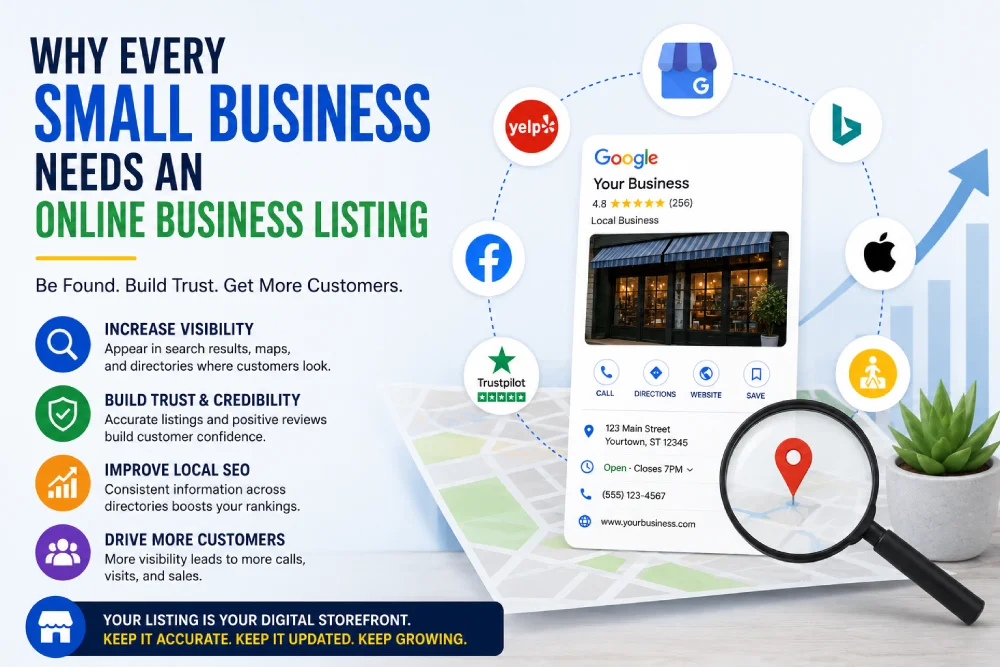
An online business listing is your digital storefront. It tells people who you are, where you are, and how to reach you. Without accurate listings, customers simply cannot find you. Most small business owners think they do not need one. Or they think one listing is enough. Both are wrong.
A legitimate business listing is an online profile that provides essential information about a company. It includes the name, address, phone number, website, hours of operation, and services offered.
These listings appear on online business directory sites, search engines, and maps. Google Business Profile is the most important, but Yelp, Bing Places, Facebook, and Apple Maps matter too.
It is the foundation of any digital presence. Without it, people cannot find your business when they search online.
The numbers tell the story. 94% of consumers use online directories to find local businesses when they need one. If your listing is incomplete or missing, you are invisible to those customers.
Business listings for SEO matter because search engines use consistent listings to verify that a business is legitimate. When your name, address, and phone number match across directories, Google trusts you more. That trust translates to higher search engine rankings in local search results.
One study found that 62% of consumers would avoid a business if they found incorrect information online. That means even one wrong phone number can lose customers.
-1783548370.webp)
A citation is a mention of your business name, address, and phone number on another website. Search engines use these citations to verify that your business is real.
The more citations from trusted directories, the better. But consistency is key. If your address appears differently on different online business directory sites, search engines get confused and your rankings drop.
A complete listing with photos, descriptions, and categories also improves visibility. Google rewards businesses that provide detailed information.
The biggest cost is lost customers. When people search for "plumber near me" or "best coffee shop in [city]," the businesses that show up get the calls. Those without listings do not.
Outdated listings cost money too. If your phone number is wrong, customers call someone else. If your hours are wrong, people show up when you are closed. They get frustrated and go to a competitor.
There is also the reputational cost. A business that cannot keep its online visibility straight looks unprofessional. Customers wonder: if they cannot manage their listing, how will they manage my service?
The first step is claiming your Google Business Profile. Next, expand to other online business directory sites such as Yelp, Bing Places, Facebook, Apple Maps, and industry-specific directories. Each listing sends signals to search engines and helps customers find you.
Choose directories wisely and focus on high-authority directories first. Industry-specific directories are also valuable.
Your business name, address, and phone number must match exactly across every listing. Even small variations like "Street" versus "St." can hurt search engine rankings.
A complete listing with visuals, detailed descriptions, and categories performs better. It attracts more attention and builds trust.
Review your listings monthly. Update holiday hours, add new services, and keep every detail accurate.
Reviews build credibility. Responding to reviews shows customers you care. A strong reputation management strategy includes monitoring and engaging with customers.
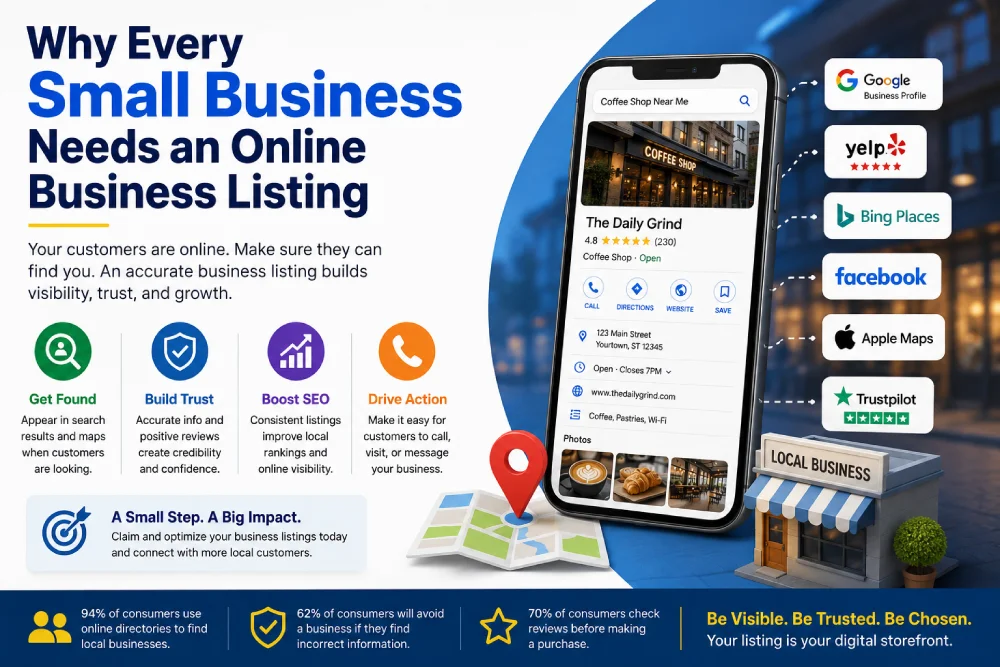
Customer reviews are part of every business listing on major platforms. They influence both search engine rankings and purchasing decisions.
70% of consumers check reviews before making a purchase. Positive reviews build trust, while negative reviews can damage a business if ignored.
Responding to reviews matters. One study found that 28% of people always leave a review when asked. Thank satisfied customers, apologize when necessary, and always remain professional.
Managing multiple listings manually is time-consuming, and mistakes can happen. AI-powered tools now automate many aspects of business listing management.
Platforms such as Thryv use AI to generate service descriptions, respond to reviews, and keep information consistent across multiple directories.
These tools also track performance by showing which listings generate the most traffic and phone calls. That data helps improve your digital marketing strategy.
The good news is that setting up business listings is free on most major platforms. Google Business Profile, Yelp, and Bing Places all offer free listings.
The time investment pays off quickly. Better online visibility leads to more customers, stronger trust, improved local SEO, and higher search engine rankings.
It is an online profile with your business name, address, phone number, website, and other important details. It helps customers find you in search results and on maps. Without one, your business is much harder to discover online.
Search engines use listings to verify your business information. Consistent listings across trusted directories build credibility, improve local SEO, and help your business rank higher.
Start with Google Business Profile, Yelp, Bing Places, Facebook, Apple Maps, and Better Business Bureau. Industry-specific directories can also provide valuable visibility.
Include your business name, address, phone number, website, business hours, services, categories, photos, and a detailed business description.
Use the exact same business name, address, and phone number everywhere. Avoid small variations such as "Street" and "St." Review your listings monthly or use management tools to automate updates.
Yes. AI-powered tools such as Thryv can generate descriptions, automate updates, respond to reviews, and reduce manual work while keeping information accurate.
Customer reviews influence buying decisions and local search rankings. Positive reviews build trust, while responding professionally to all reviews improves your online reputation.
Review your listings at least once a month. Update business hours, add new services, upload fresh photos, and correct outdated information.
Duplicate listings confuse both search engines and customers, reducing your local SEO performance. Find duplicate listings and merge or remove them whenever possible.
Yes. Social media complements business listings but does not replace them. Customers still rely on Google Search, Google Maps, Yelp, and other online directories to find local businesses.

Comments (0)