
Blog
- Home
- Blog
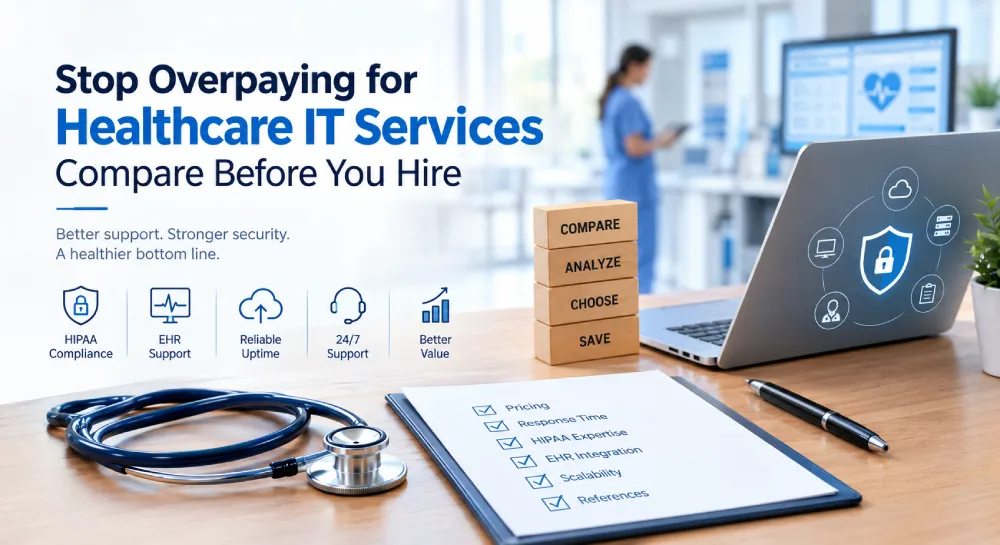
Patients, staffing, compliance and billing are far more important than an IT bill that continues to rise. The issue is that... Many practices are getting top dollar for average support. They remain with the first provider they signed up with or the one that their colleague used years ago. And they will not cease to compare.
Healthcare IT services are not a uniform quality. There are enterprise rates for basic support too, some. You have to pay some nickel and dime for each ticket. Not all of them are fully aware of HIPAA or clinical workflows. Some are really good and quite affordable. The only way to determine the difference is to compare before hiring.
Managed healthcare IT services are not the same as general IT support. A standard IT company might keep your email running and your Wi-Fi stable. That is fine for a retail shop. But a healthcare-focused provider does much more.
They must understand HIPAA compliance inside and out. They must secure patient data. They must ensure your clinical IT systems stay online because downtime can affect patient care. They must work with EHR vendors, manage healthcare IT infrastructure, and support the unique workflows of a medical practice.
That specialization costs money. And honestly, it should. But not every provider delivers equal value. Some charge premium rates while offering generic support with a HIPAA sticker on it. You need to know what you are actually paying for.

When comparing healthcare IT solutions providers, do not just look at the monthly price. That is the biggest mistake practices make. Look at what you are getting for that price.
Most practices overspend in three areas.
First, they pay for enterprise-level infrastructure they do not need. A small clinic does not require the same healthcare IT infrastructure as a hospital system. You need right-sized solutions. Not the biggest and most expensive option on the menu.
Second, they stay with legacy providers who have not updated their pricing or their technology. Loyalty is good. But not when it costs you thousands every year for outdated support.
Third, they hire general IT companies to handle health it consulting and then pay separately for healthcare-specific expertise. That is double the cost for half the value. You end up paying one company to manage your network and another to tell them what HIPAA actually requires.
Start by listing your actual needs. Do you only need support for medical office operations? Or do you also need strategic health consulting? Are you a medical practice or a dental IT services provider? Each has different requirements and different compliance obligations.
Then get quotes from at least three providers. Ask each one the same questions. Compare not just price, but scope of service, response time, and healthcare experience. Ask for references. Talk to other practices. Find out if the provider actually delivers on their promises or just talks a good game.
You do not have to overpay for healthcare IT. But you do have to compare. The right provider will save you money, reduce downtime, and keep your practice compliant. The wrong one will cost you more than you realize—in money, in time, and in stress.
Do the work upfront. Ask the hard questions. And choose a partner who actually understands your world.
Healthcare IT services include managed IT support, cybersecurity, EHR management, HIPAA compliance, infrastructure management, and strategic consulting for medical practices, clinics, and dental offices. They are designed to meet the distinctive requirements of a clinical setting.
Managed healthcare IT services are continual IT assistance and management provided by someone other than the healthcare organization. They manage your infrastructure, security, compliance, and clinical systems so you don't have to worry about technology issues.
Prices are different depending on the size. Most providers have monthly fees per user and/or per device. If you want to avoid overpaying, the best way to do it is to compare a number of quotes. Don't assume that a lower price means that it's the highest quality.
Compliance with HIPAA in IT translates to taking steps to safeguard patient data. This means using encryption, implementing access controls, keeping track of logs, training employees and signing a Business Associate Agreement with your IT provider.
Keep an eye out for HIPAA knowledge, EHR experience, guaranteed response times, scalability, clear pricing, and references from other practices. Don't only consider the cost. Compare value.
IT support for medical offices includes troubleshooting, maintenance of systems, security monitoring, and user support. It should be customized for a healthcare setting where interruptions to operations have a direct impact on patient care.
Health IT consulting is advice regarding technology decisions. It encompasses EHR selection, healthcare infrastructure planning, cybersecurity evaluation, and optimization of healthcare workflow.
Clinical IT systems range from EHRs and practice management programs to e-prescribing software, lab communication systems and imaging systems. These are the essential technology systems that are the backbone of your practice and enable patient care.
Healthcare IT infrastructure consists of servers, networks, workstations, storage, and security systems. It should be dependable, secure, and conform to healthcare regulations for clinical operations.
Dental IT Services are IT support and services specifically designed for dental offices. They use practice management software assistance, imaging systems, HIPAA compliance, and cybersecurity. Dental practices require special attention that the generic IT businesses don't offer.
