
Blog
- Home
- Blog
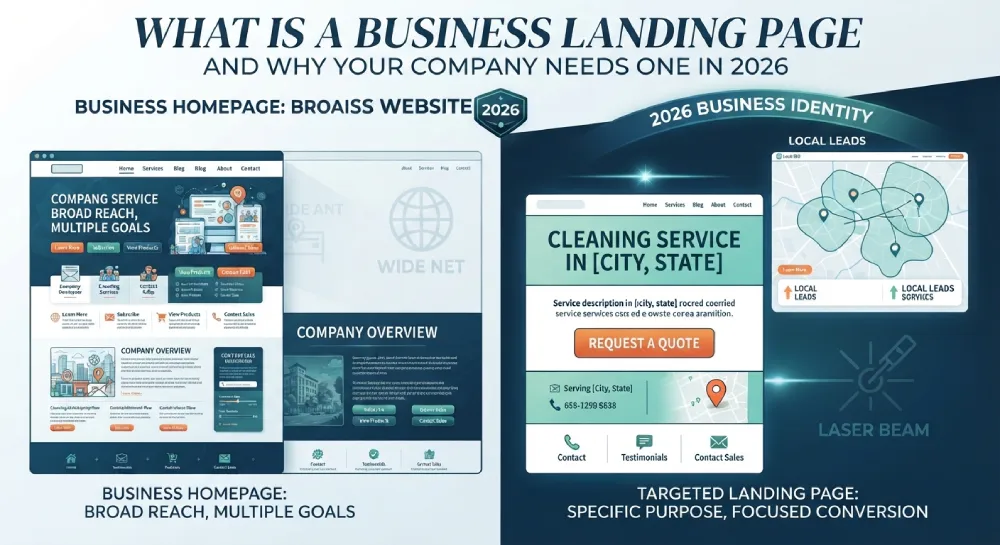
A business landing page offers a way to convert website visitors into leads, customers, or inquiries. Even if a company has a website that shows its services and products, many visitors will leave the page without taking any specific action. To increase the conversion rate, a company may consider creating a landing page.
A landing page focuses on one service, offer, business location, or customer action. This article explains how it differs from a business website, how it supports local search, and what digital business identity should include to turn relevant visitors into leads.
A business landing page is a single page on a website that is designed to pursue one specific purpose to generate phone calls, request quotes or appointments, record sales leads or subscriptions. Contrary to the homepage, landing pages are concentrated on one service, product, target audience, or action.
| Landing Page | Business Website |
|---|---|
| Focuses on one goal | Covers the whole business |
| Targets specific local intent | Serves broader needs |
| Uses a focused CTA | Has multiple navigation options |
| Supports conversions | Builds overall online presence |
A quality landing page should contain the following elements:
The elements of the landing page should not be randomly selected. On the contrary, the landing page should be built in such a way that the customer can easily understand what the company offers and choose the next step.
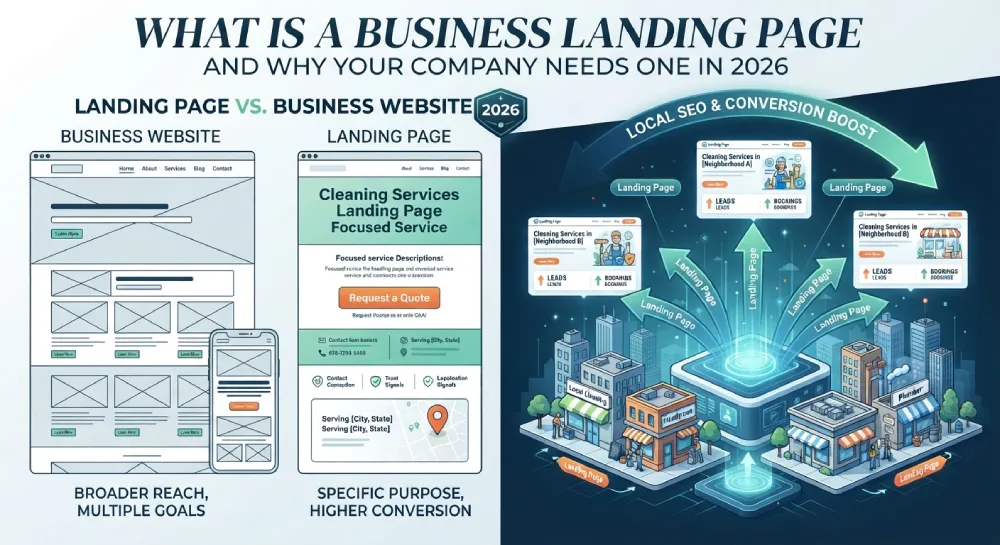
A business landing page can help a company meet the requirements of local SEO. For instance, if a customer searches for a specific service in a specific location, a landing page can satisfy this search intent.
A company that has a physical office can provide the address on the landing page. In addition, businesses can give more information about their services, products, areas of operation, and other topics of interest to the customer.
If the company offers local services, for example, cleaning, it can develop a set of landing pages for the most popular localities that the company serves. In this case, one should avoid using the same content for all the landing pages, as it is against best practices to do so. Rather, the company should provide more information about the specific locality that one chooses.
It should be created based on the intent of the customer. The following steps should be taken to create a landing page that converts:
1. Choose one goal
Decide whether you want calls, bookings, sales, or quote requests.
2. Match search intent
Understand what the visitor wants and answer that need quickly.
3. Explain the value
Clearly state what you offer, who it helps, and why it is relevant.
4. Add trust information
Include accurate company background, contact details, service information, and legitimate trust signals.
5. Make the CTA clear
Use a direct action such as “Request a Quote,” “Book Now,” or “Call Today.”
Creating a landing page that combines a service and a specific location can be a smart idea to compete with other companies. In particular, localized landing pages can target customers who are interested in the services that the company provides and live in a specific area.
In 2026, businesses should use local SEO for service area pages to optimize the content on their website. When creating brand identity for small business, the company should provide the information that the customer would find useful, not just the name of the area.
If a company provides the same service in different areas, it may have a primary category landing page, which serves as the primary page for the service. Then, for each area that the company serves, the company should create a localized landing page. This way, the company will target each area as a standalone location.
-1789163031.webp)
A business landing page can be used to strengthen brand positioning for a small business. In particular, a company can use the same page to ensure that the website visitor receives the same message, whether on the website, on Google, in the directory, or on social media.
A company can build brand authority by providing customers with accurate information, such as the company’s history, services, location, and other details. In other words, a high-quality landing page strengthens brand authority by building customers’ trust in the company.
A business landing page is an important tool that a company can use to increase its conversions and collect more leads in 2026. In addition, a landing page can be used to satisfy the local SEO requirements, which would make the website appear in the search results in front of the customers who search for a specific service in a specific location.
A business landing page is a page on a website focused on a single goal, such as generating phone leads or quotes. A landing page will not have any other information on it about the company, as opposed to the homepage.
A homepage provides general information about the company, while a landing page is a specific page that is focused on a specific purpose.
A landing page helps a business reach a higher conversion rate in 2026, as it would help the business meet the intent of the website visitors and satisfy the local SEO requirements.
A landing page can help a business with local SEO if the business has a local presence. In this case, a landing page that combines a service and a specific location may target a specific area and will be beneficial for the local SEO of the company. To satisfy the local SEO requirements, a landing page should have the correct information about the service that the company provides.
The business landing page should contain an appealing headline, a short description of the company’s service or product, value proposition, contact details, trust indicators, and a prominent call-to-action (CTA).
Local SEO landing pages target specific areas and specific intents of website visitors. A business landing page should provide the information that the customer is looking for.
A business should create different landing pages for different locations if the company provides services in these locations. The company should avoid creating page duplicates with the same information, as this would be considered a poor SEO practice.
A service-area landing page is a local SEO landing page that is aimed at targeting a specific area.
A landing page can help build a brand by providing accurate information about the company and by giving the same message to the customers on different platforms.
Provide a clear message to the customer, make the page easy to use and navigate, and ensure that the phone number and other contact details are easy to find.
